01 Pick your destination
Solar Exploration
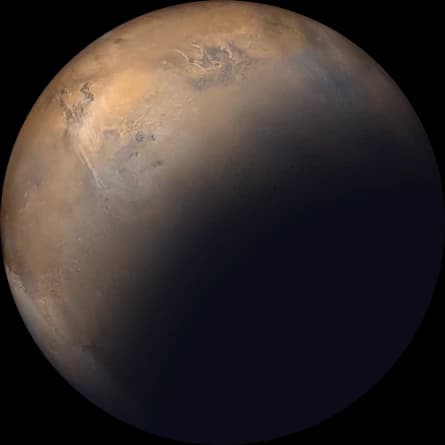
Mars
The rust-red frontier
Avg. Distance
Year Length
Moons
Composition
Rocky, iron-oxide-rich surface (the source of its red color)
Surface Gravity
3.72 m/s²
Mean Temperature
-65°C (average)
Atmosphere
Thin — 95% carbon dioxide, under 1% of Earth's surface pressure
About Mars
Overview & Geology
Mars is the most Earth-like of the rocky planets in terms of geography, with polar ice caps, seasons, canyons and dust storms that can occasionally engulf the entire planet. Its rust-red color comes from iron oxide — essentially rust — coating its dusty surface. Mars is home to Olympus Mons, the largest volcano in the solar system at roughly three times the height of Mount Everest, and Valles Marineris, a canyon system long enough to stretch across the continental United States.
The planet's two small moons, Phobos and Deimos, are irregularly shaped and thought to be captured asteroids rather than bodies that formed alongside Mars. Phobos orbits so close and fast that it rises and sets twice a day as seen from the Martian surface, and it's slowly spiraling inward — in tens of millions of years it will either crash into Mars or break apart into a ring.
Mars's atmosphere is a hundred times thinner than Earth's, too thin to support liquid water on the surface today — any exposed water instantly boils or freezes. But evidence from rovers and orbiters shows Mars once had rivers, lakes, and possibly an ocean billions of years ago, before it lost most of its atmosphere to space as its magnetic field faded. That ancient wet history is exactly why Mars remains the solar system's leading candidate in the search for evidence of past microbial life.
Historical Missions
Exploration Milestones
Mars has been visited by more spacecraft than any planet besides Earth, though it has also destroyed more missions than any other world — roughly half of all Mars missions ever attempted have failed, a track record that's earned it the nickname 'the planet that eats spacecraft.' Despite that, it's now the most thoroughly mapped and roved planet after Earth.
Viking 1
1976The first spacecraft to successfully land on and operate from the Martian surface, returning the first close-up color images of Mars.
Curiosity
2012A car-sized rover still active today, confirming ancient lakebeds and organic molecules inside Gale Crater.
Perseverance
2021Currently caching soil samples for eventual return to Earth while its companion helicopter, Ingenuity, proved powered flight is possible on Mars.
NASA Gallery
Real Mission Photos

Mars Celebration

Mars Celebration

Mars Celebration

Mars Celebration

Mars Celebration
Mars Celebration
Mars Celebration