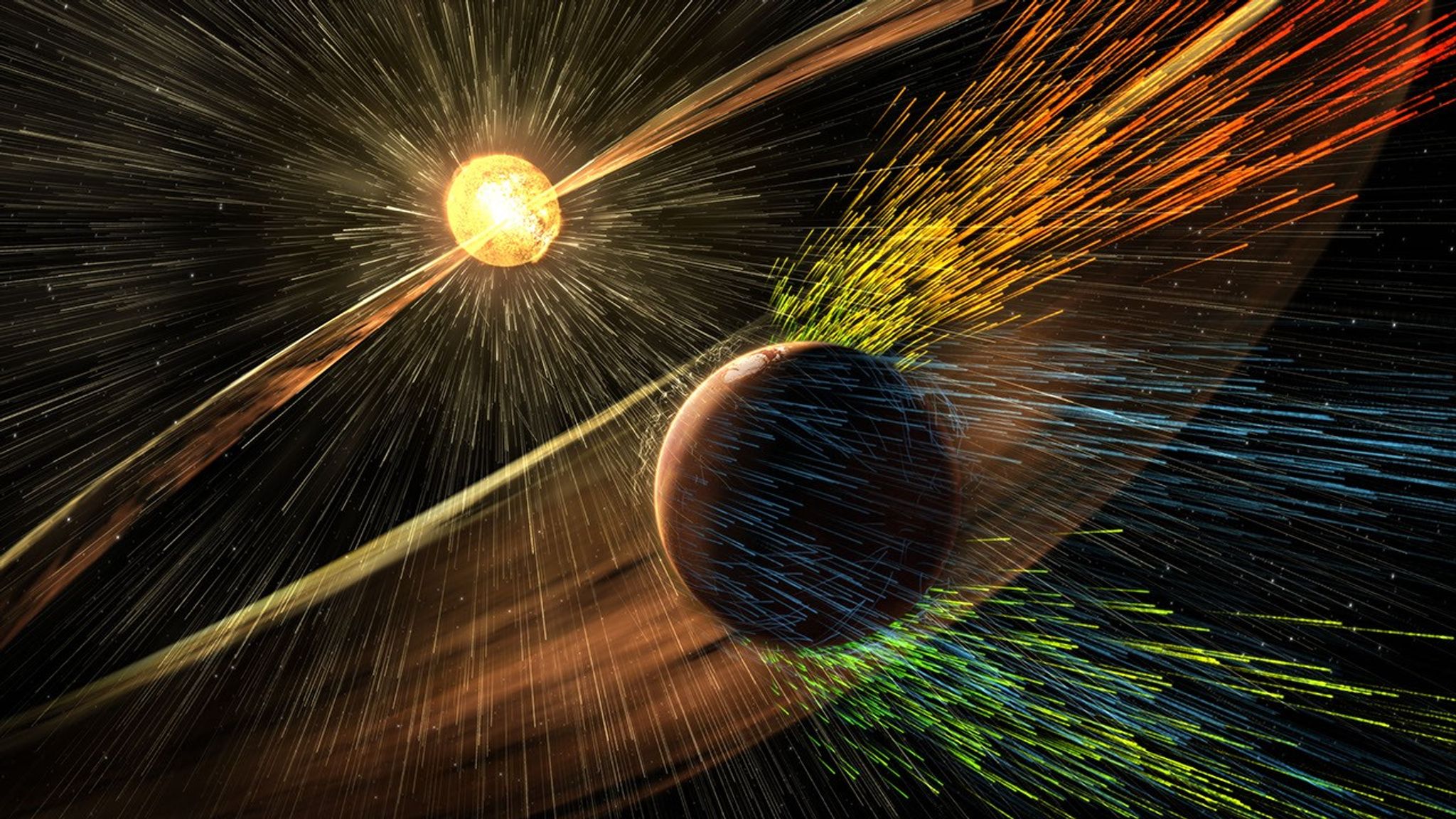
Understanding How Martian Auroras Are Made
Quick Summary
This July 23, 2026, illustration depicts charged particles from a solar storm stripping away charged particles of Mars’ atmosphere, one of the processes of Martian atmosphere loss studied by NASA’s MAVEN (Mars Atmosphere and Volatile Evolution) mission. NASA MAVEN mission scientists have found that certain types of auroras on Mars form in a similar way […]
Space Explainer: The ISS & Life in Orbit
The International Space Station has been continuously staffed since November 2000, making it the longest-running human outpost off Earth. It orbits roughly 400km up, circling the planet every 90 minutes at about 28,000 km/h — meaning the crew sees a sunrise or sunset every 45 minutes.
Crew members typically rotate every 5-6 months, arriving and departing on Soyuz or Crew Dragon spacecraft. Their days are tightly scheduled around scientific experiments in microgravity, station maintenance, and roughly 2.5 hours of mandatory daily exercise to counteract the bone and muscle loss that comes from living without gravity.
Track the ISS Crew LiveSource: NASA
Read full story at NASA